
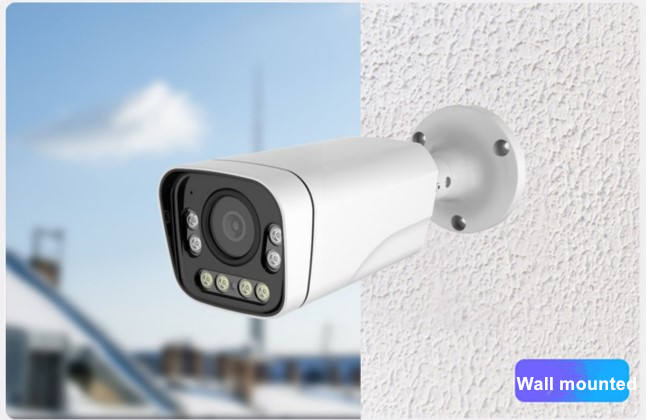
An internet protocol (IP) camera is a digital video camera that sends and receives data over a network or the Internet. Unlike traditional analog cameras, IP cameras offer higher resolution and advanced features like remote access and motion detection. They connect directly to your network, allowing you to monitor your business in real-time from any device with an internet connection. This makes them a popular choice for modern security solutions.
Types of IP cameras
Fixed IP cameras
Stationary cameras that provide a consistent field of view.
PTZ (pan-tilt-zoom) IP cameras
Cameras that can pan, tilt, and zoom to cover a wide area.
Dome&Turret IP cameras
Cameras encased in a dome, often used for discrete monitoring and protection against tampering.
Bullet IP cameras
Long, cylindrical cameras typically used for outdoor security.
Wireless IP cameras
Cameras that connect to the network wirelessly, offering flexible installation options.

What are the key functional trends of IP Cameras?
AOV (Always on Video)
Utilizing fast startup and standby technology based on ultra-low power memory, AOV successfully achieves 24/7 uninterrupted recording capability. This technology effectively overcomes the limitation of traditional low-power IPCs that cannot record images when the PIR sensor is not triggered, achieving a user experience closer to conventional power supply devices while maintaining extremely low power consumption.
Black Light
Based on a high-sensitivity image sensor and combined with an AI-ISP imaging system, it can maintain full-color image display even in extremely low light environments as low as 0.0005 Lux (illuminance measurement unit), without the need for additional lighting equipment. From “starlight” to “super-starlight,” and now to the advent of “black light” technology, it signifies the continuous pursuit and breakthroughs in image resolution, quality, and stability under complex lighting conditions.
Combination of Gun and Dome Cameras
Gun cameras generally have a relatively fixed field of view, suitable for focused tracking and monitoring within a certain area; dome cameras can adjust the field of view 360° by rotating and moving the pan and tilting the head, providing a wider monitoring range; while the combination of gun and dome cameras, as the name suggests, combines the advantages of both gun and dome cameras, allowing one device to cover both panoramic and detailed views.
Four types of power supply methods for network cameras
Battery Power
This method relies on a built-in lithium battery pack for power, eliminating the need for an external power outlet. It’s commonly used for camera equipment where external power is inconvenient and power consumption is low.
Power Over Ethernet (POE)
Data transmission and power supply can be completed simultaneously via a single Ethernet cable. Installation is simple, cabling costs are low, and device placement is flexible, unrestricted by power outlet locations.
Power Adapter Power
This method uses an AC/DC power adapter with a suitable voltage and current range for independent power supply. It offers good stability and is widely compatible with devices of various power specifications.
Solar Power
This method efficiently converts solar energy into electrical energy using solar panels. Maximum Power Point Tracking (MPPT) technology further enhances the output efficiency of the solar panels, and the energy is then stored in batteries. This provides a continuous and stable power supply for network cameras, fully utilizing renewable energy and reducing carbon emissions. It is suitable for outdoor and field locations where wired power supply is inconvenient.
Why IP cameras are important or useful
IP cameras are crucial for enhancing security due to their high-resolution video and advanced features like motion detection, which help identify and respond to threats quickly. Remote monitoring allows business owners to access live feeds from anywhere, ensuring constant oversight even when they are off-site. These cameras are also cost-effective; features like Power over Ethernet (PoE) reduce the need for multiple cables and infrastructure. Additionally, IP cameras offer easy scalability, enabling businesses to expand their security coverage as needed.
Flexible storage options, including local and cloud storage, provide versatile solutions for data management and retrieval. IP cameras can also improve productivity by allowing employers to monitor employee activity, optimize operations, and ensure adherence to company policies. Finally, high-quality video recordings from IP cameras serve as valuable evidence in legal and insurance cases, helping to resolve disputes and claims efficiently.
