
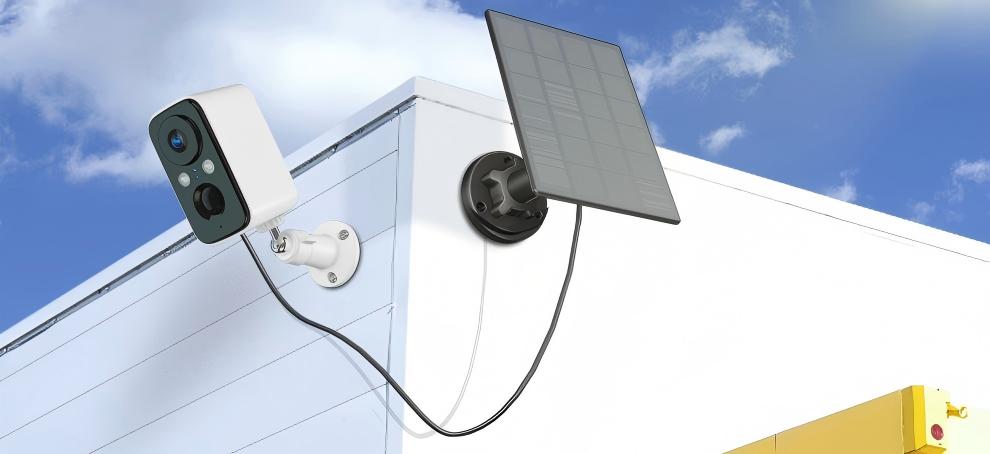
After battery-powered low-consumption cameras solved the pain point of “frequent charging”, the outdoor monitoring field has ushered in a new upgrade – solar-powered low-consumption cameras. By perfectly integrating solar energy, a clean energy source, with low-consumption technology, they not only inherit the installation flexibility and intelligent performance of battery-powered models but also achieve long-lasting battery life through “charging with sunlight”, completely breaking the energy constraints of outdoor monitoring. Whether it is a remote mountain orchard or an unattended construction site, they can operate stably with their “self-sufficient” energy mode. Today, we will comprehensively interpret this “uninterruptible” security artifact.
What is a Solar-Powered Low-Consumption Camera?
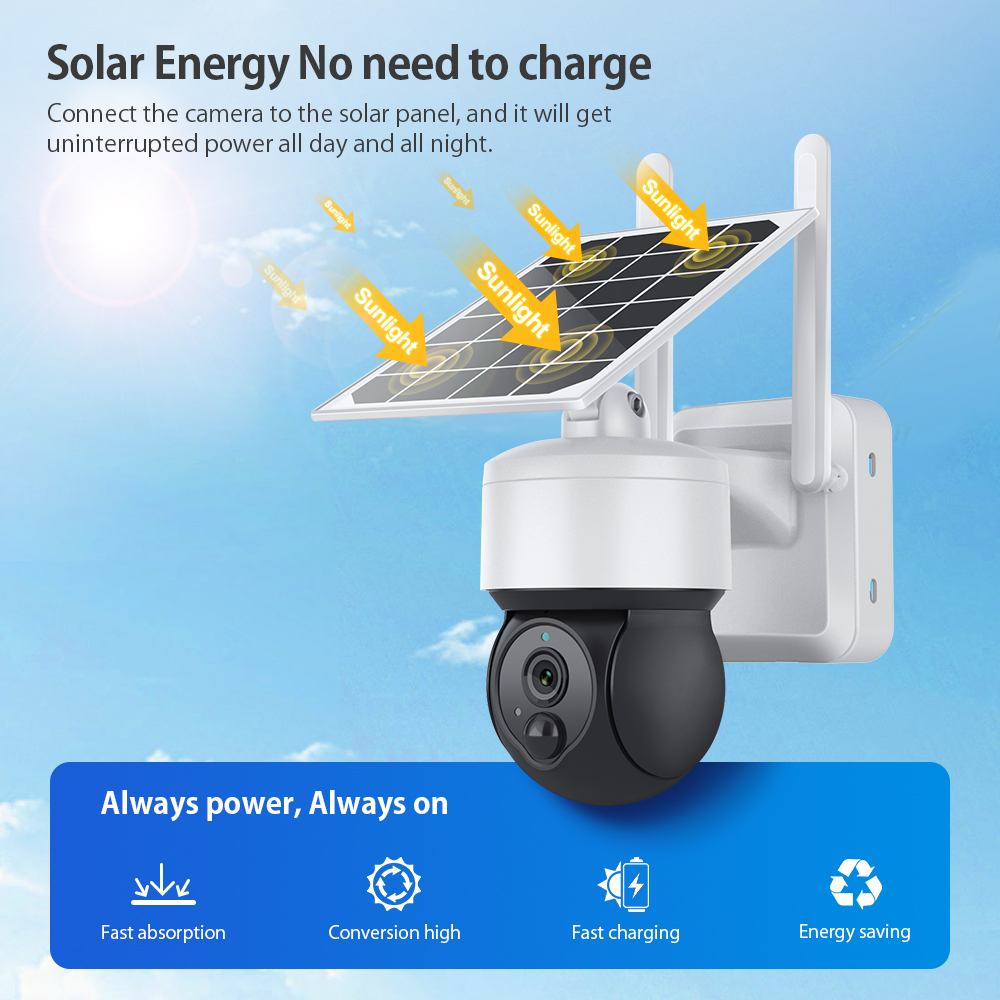
A solar-powered low-consumption camera is a new type of monitoring device upgraded from battery-powered low-consumption cameras. Its core feature is the integration of a solar charging module (usually a high-efficiency monocrystalline silicon solar panel), which can convert solar energy into electrical energy and store it in a lithium battery to provide continuous power for the camera. It is not a simple combination of “solar panel + camera”, but realizes a closed-loop operation of “solar charging – battery storage – low-consumption discharge” through an intelligent energy management system.
Compared with traditional solar cameras, its “low-consumption” attribute is particularly critical: traditional solar cameras mostly operate continuously, which have high requirements for solar panel power and battery capacity. In contrast, solar-powered low-consumption cameras inherit the core “motion wake-up” technology, staying in a dormant and energy-saving state normally and only activating when effective motion is detected. This enables them to meet long-term battery life requirements even with small-sized solar panels. Simply put, it is a dual combination of “clean energy supply” and “intelligent low-consumption operation”.
Core Features of Solar-Powered Low-Consumption Cameras
The features of solar-powered low-consumption cameras revolve around “energy autonomy” while meeting the core needs of monitoring equipment, which can be specifically summarized into the following four points:
1. Self-Sufficient Energy: Charge with Sunlight, No Manual Intervention
This is the most prominent feature of solar-powered low-consumption cameras. The high-efficiency solar panels they are equipped with have a conversion rate of more than 23%, which can effectively absorb light energy and convert it into electrical energy even in low-light environments such as cloudy days; combined with large-capacity lithium batteries, excess electrical energy can be stored for use at night or in rainy weather. Some high-end products also support a dual-mode of “solar energy + USB backup charging”, which can supplement power through an external power supply even in extreme weather, ensuring reliable energy supply.
This energy mode has completely changed the maintenance logic of outdoor monitoring – after installation and commissioning, as long as there is sunlight, the device can complete charging independently without regular manual battery replacement or connection to the mains. It is especially suitable for scenarios where manual maintenance is inconvenient, such as remote areas and mountainous regions.
2. Intelligent Energy Management: Dynamically Adapt to Working Conditions, Optimize Energy Distribution
The built-in intelligent energy management system is the core guarantee for “low consumption” and “long battery life”. The system continuously monitors battery power, light intensity, and device working status, and dynamically adjusts energy consumption strategies: when the light is sufficient and the battery is fully charged, it will automatically reduce the charging power to avoid overcharging the battery; when the light is insufficient or the battery power is low, it will give priority to ensuring core monitoring functions and appropriately reduce energy consumption of non-essential functions (such as temporarily turning off HD preview); at night, it only maintains the low-consumption detection mode to ensure the normal operation of the motion wake-up function.
3. 24/7 Stable Operation: Strong Environmental Adaptability, Unafraid of Extreme Weather
To adapt to complex outdoor environments, solar-powered low-consumption cameras pay special attention to durability in hardware design. The solar panels are encapsulated with scratch-resistant and corrosion-resistant tempered glass, which can resist wind, sand, rain, and snow erosion; the main body of the camera has a waterproof and dustproof rating of IP66 or higher, and can work normally in an extreme temperature range of -30℃ to 60℃. Whether it is the snowy winter in the north or the hot and rainy weather in the south, it can operate stably.
Some products have also optimized the heat dissipation design for strong sunlight environments to prevent performance degradation due to high temperatures, ensuring 24/7 uninterrupted monitoring.
4. HD Intelligent Monitoring: Full-Core Performance, Balancing Details and Efficiency
Like battery-powered low-consumption cameras, they make no compromises in monitoring performance. They support 1080P full HD image capture, and some high-end models can reach 4K resolution. Combined with wide dynamic range technology, they can clearly capture key details such as human faces and license plates even in backlit environments; the intelligent motion detection function can accurately distinguish effective targets such as people and vehicles from interference factors such as wind-blown vegetation and falling leaves, reducing false alarms; at the same time, they support remote real-time viewing, motion tracking, sound and light alarms, and other functions to meet the core needs of security monitoring.
Unique Advantages of Solar-Powered Low-Consumption Cameras
Compared with ordinary battery-powered low-consumption cameras and traditional mains-powered cameras, solar-powered low-consumption cameras show irreplaceable advantages in outdoor scenarios, which are specifically reflected in the following three dimensions:
1. Extremely Low Operation and Maintenance Costs: One-Time Investment, Long-Term Benefits
From the perspective of long-term use costs, solar-powered low-consumption cameras have extremely obvious advantages. Although the initial investment is higher than that of ordinary battery cameras due to the solar panel, there are almost no maintenance costs in the later period – no electricity fees need to be paid, no manual battery replacement is required, the equipment failure rate is low, and the service life can reach more than 5 years. For scenarios that require large-scale deployment (such as orchards, farms, and logistics parks), it can significantly reduce long-term operation and maintenance expenses, and the cost-effectiveness advantage becomes more prominent as the use time increases.
2. Unrestricted Deployment Scenarios: Breaking the Constraints of Power Supply and Network
It completely breaks away from the dependence on the mains and wired networks: remote mountainous areas and wild fields without power supply can rely on solar energy for independent power supply; areas without broadband networks can be equipped with 4G/5G modules to realize data transmission, truly achieving “deploy wherever monitoring is needed”. This flexibility makes it shine in many scenarios: used in the agricultural field for orchard anti-theft and crop growth monitoring; in the forestry field for forest fire prevention and wild animal observation; in the engineering field for construction site progress monitoring and material anti-theft; and in the security field for public security patrols in remote roads and border areas.
3. Green and Environmentally Friendly: Practicing Low-Carbon Concepts, Reducing Energy Waste
Under the “dual carbon” concept, the environmental protection value of solar-powered low-consumption cameras cannot be ignored. It uses solar energy as the main energy source, does not consume grid electricity, and reduces the indirect consumption of fossil energy; the low-consumption design itself also reduces energy waste. Combined with the clean energy attribute of solar energy, it realizes “zero carbon emission” monitoring operation. For enterprises or individuals who value environmental protection images, choosing such equipment is also an important manifestation of practicing a low-carbon lifestyle.
Final Thoughts: The “Ultimate Solution” for Outdoor Monitoring
The emergence of solar-powered low-consumption cameras marks that outdoor monitoring has entered a new era of “energy autonomy, intelligence, and efficiency”. It not only solves the problems of difficult wiring and high costs of traditional mains-powered cameras but also makes up for the shortcoming of ordinary battery cameras that require frequent maintenance. Through the triple technical support of “solar energy + low consumption + intelligent management”, it realizes an outdoor monitoring experience of “install once, worry-free for a long time”.
With the continuous upgrading of solar energy technology and low-consumption chips, such equipment will achieve higher energy conversion rates and more intelligent scenario adaptation capabilities in the future, further expanding the application boundaries. If you have outdoor monitoring needs and hope to balance convenience, economy, and environmental protection, solar-powered low-consumption cameras are undoubtedly the best choice at present – they are not only a monitoring device but also an “unfailing” clean energy security guard.
